Menu


Free Confidential Consultations: 216-223-7535
Free Confidential Consultations: 216-223-7535


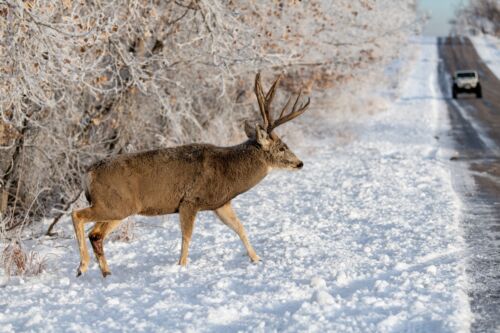
Every year, drivers throughout Ohio are involved in car crashes caused by deer. Car crashes caused by deer are more likely to occur in the fall, during deer mating season, and again in spring when young deer begin to explore on their own.
At Robenalt Law, we want to educate our clients about the risks of car deer crashes, provide clear steps for what to do in the event of a car deer crash, and share safety tips to avoid a car deer crash.
While deer and car crashes can happen almost anywhere, they are most likely to occur in suburban and rural areas, particularly where habitat transitions, such as forest-to-field, occur. Roads near wooded areas or water sources pose a higher risk as deer are attracted to these habitats.
A car deer crash is most likely to occur at dusk or dawn, when deer are more active and driver visibility is reduced. The moon phase also seems to be a factor. Nights with a full moon carry an increased risk of car deer crashes, as brighter light causes deer to travel greater distances and cross more roads.
If you hit a deer, do your best to stay calm and keep yourself and your passengers safe. Pull to the side of the road and turn on your hazard lights. Avoid approaching the animal, as an injured deer can behave unpredictably.
Once it is safe to do so, take photos of the damage to your vehicle and, if possible, the surrounding area.
The cost of hitting a deer can go beyond a dented bumper. Modern vehicles are equipped with sophisticated electronics systems, and seemingly minor damage may require costly repairs.
Beyond the repair costs, a car deer crash can cause injuries to you and your passengers. If you or one of your passengers was injured in a car crash with deer, contact the police and EMS and seek medical attention.
Although some car deer crashes are unavoidable, you can reduce the likelihood of an accident.
Comprehensive insurance covers most car deer collisions. But if you have liability-only coverage, the damage may not be covered by your insurance. Contact your insurance carrier to determine whether your policy covers collisions with wildlife.
Most car deer crashes are considered no-fault accidents and will not affect your insurance premiums. However, every insurance carrier is different, so it may be worth discussing the matter with yours.
If you were injured in a car deer crash, have questions about liability or insurance coverage, or your insurance carrier is denying your claim, Robenalt Law can help.
Robenalt Law has offices in Cleveland and Columbus, and handles personal injury claims throughout Ohio and nationwide. Call our Cleveland office at (216) 223-7535 or our Columbus office at (614) 695-3800 or contact us online to schedule a free, confidential, no-obligation appointment to discuss your situation and how we can help.
© 2026 The Robenalt Law Firm Inc.
Legal Disclaimer | Privacy Policy
Law Firm Website Design by The Modern Firm